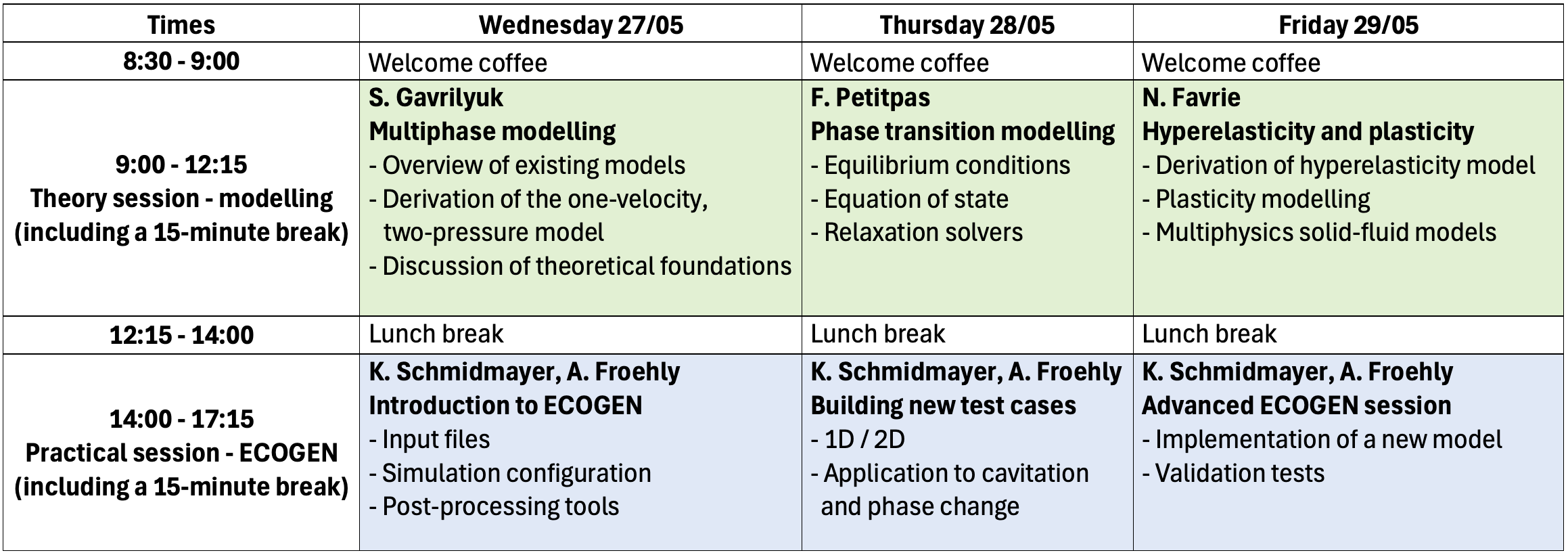




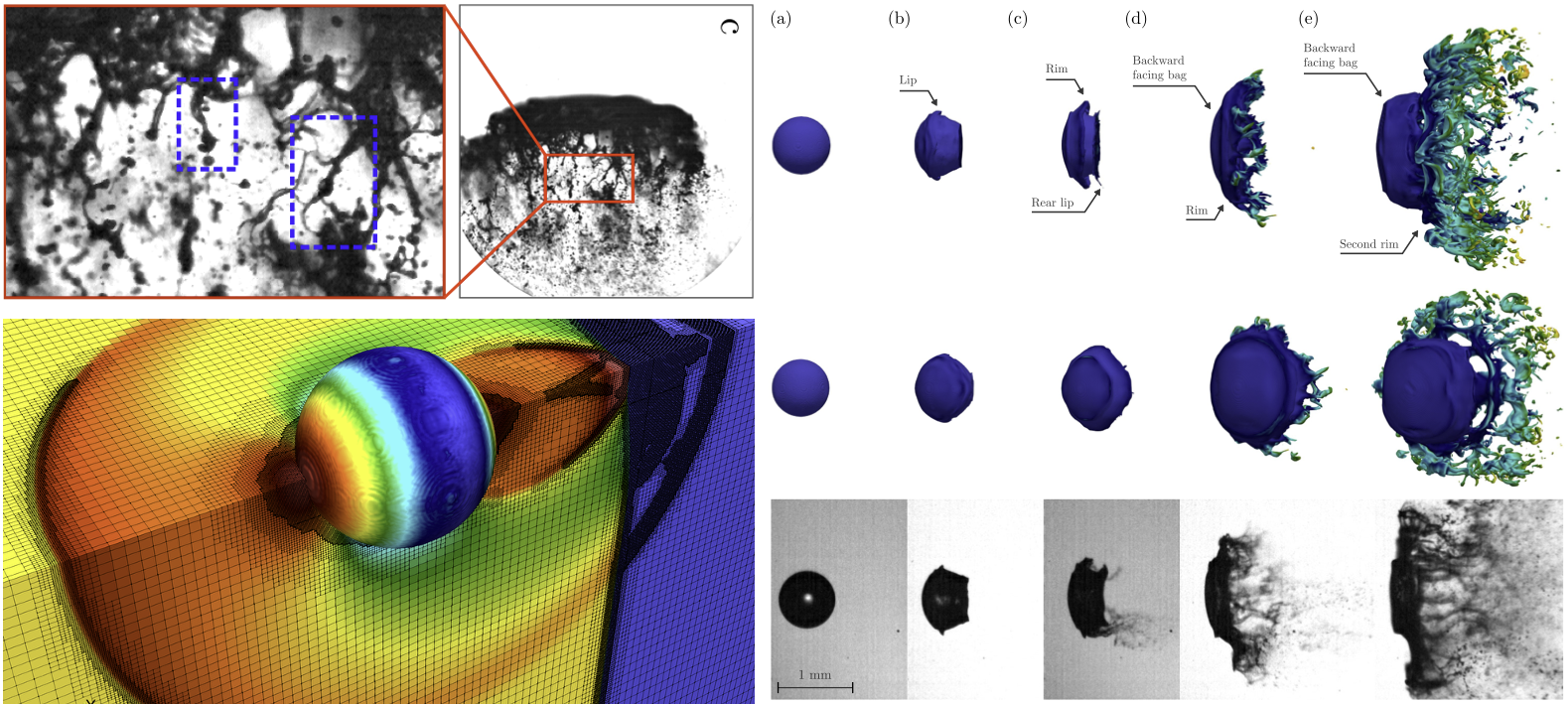
This spring school provides an in-depth introduction to the use of the open-source code ECOGEN, dedicated to advanced numerical simulations in fluid mechanics and compressible media physics. Developed notably at IUSTI and Inria, ECOGEN enables the study of complex phenomena involving multiphase flows, phase transitions, fluid–structure interactions, and reactive processes. Over three days (18 hours), participants will discover the physical and numerical foundations underlying the code. They will learn how to install and run ECOGEN, perform simulations, and analyse the resulting data. The spring school will also include practical sessions in which participants will create test cases, explore various physical models, and gain insight into extending the code.
The school combines theoretical lectures and hands-on sessions to provide a comprehensive introduction to the ECOGEN simulation framework. Participants will first be introduced to the physical and mathematical models used to describe compressible multiphase flows, including equilibrium and non-equilibrium approaches, phase transition modelling, and solid–fluid interactions. The numerical methods implemented in ECOGEN, such as finite-volume schemes for hyperbolic multiphase systems and relaxation techniques, will also be presented.
Practical sessions will guide participants through the installation, configuration, and execution of simulations, as well as the analysis of results. Attendees will learn how to prepare input files, set up and run test cases, and analyse simulation outputs. In particular, they will learn how to configure simulations on different types of computational meshes, including Cartesian grids, Adaptive Mesh Refinement (AMR) meshes, and unstructured meshes. Participants will also explore different physical models through practical examples and perform basic post-processing of the results.
Details of the agenda given below.
This school is intended for PhD students, researchers, and engineers interested in the numerical simula-tion of compressible multiphase flows, particularly those wishing to use ECOGEN in their research and industrial settings, or to develop advanced numerical models on high-performance computing (HPC) environments.
A basic knowledge of fluid mechanics and scientific computing is recommended.
S. Gavrilyuk (AMU), N. Favrie (AMU), F. Petitpas (AMU), K. Schmidmayer (Inria), A. Froehly (Inria)
The school will take place in Marseille, a major city in the south of France located on the Mediterranean coast. Marseille is the second largest city in France and offers a vibrant scientific and cultural environment. The region is well known for its exceptional natural setting, including the Calanques National Park, and benefits from a mild Mediterranean climate.
The spring school will be hosted at the Institut Universitaire des Systèmes Thermiques Industriels (IUSTI), part of Aix-Marseille University, located in the Château-Gombert Technopole. Marseille can be easily reached via Marseille Provence Airport, which provides regular shuttle connections to Marseille city centre, or via Marseille Saint-Charles railway station, served by high-speed TGV trains from major French and European cities. From the city centre, the campus can be reached using metro and bus connections.
Detailed travel information will be provided to registered participants.
The fee covers lectures, practical sessions, course materials, coffee breaks and lunches.
Participants are expected to bring their own laptop to follow the practical sessions. Participants should ensure that they are able to compile and run a simple MPI C++ program before the school. Thus, the following setup is required:
Participants should also install the following open-source software prior to the school:
Detailed installation instructions will be provided to registered participants before the school sessions.
Participants interested in attending the school are invited to register by sending an email to the organisers (ecogen@code-mphi.fr). The registration request should include:
Due to the hands-on nature of the school, the number of participants is limited. Registrations will be accepted on a first-come, first-served basis, with priority given to participants whose research or industrial activities are closely related to the topics of the school.
Registration deadline: April 30, 2026.
After confirmation of registration, participants will receive practical information regarding: